What my phone-free desk taught me about why it's so hard to find focus at work
Published on December 04, 2025
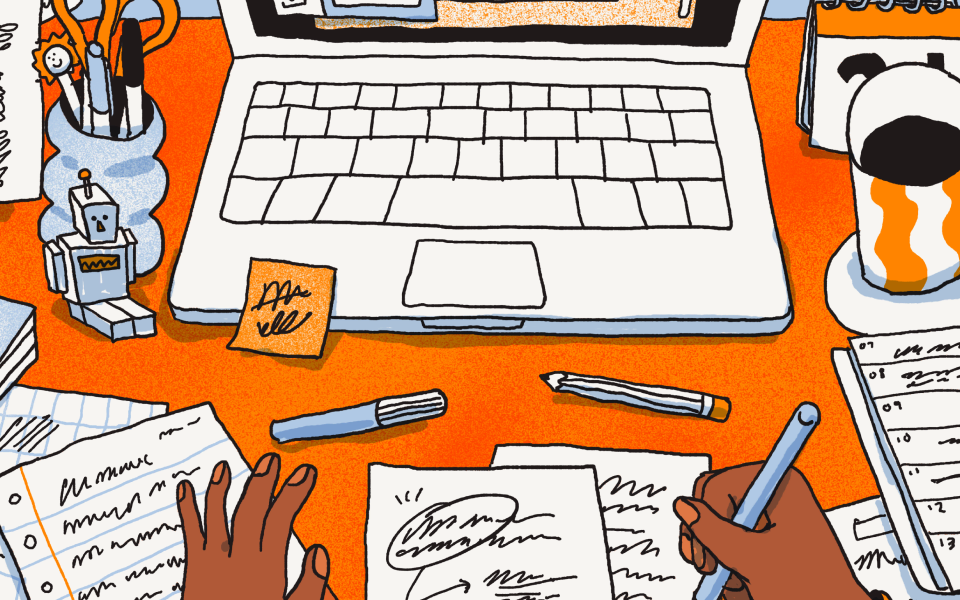
I write at a butcher block-topped workbench I’ve had for about five years. It is imperfect, scarred just a bit. I know its surface by touch. In some places the grain rises and in others it dips. I know the spot where my orbital sander went rogue. And I also know embarrassingly well where my hand used to drift whenever I hit a sentence I didn’t want to write. It’s a spot just to the right of my mouse… where my phone sat, of course.
Any time writing a paragraph got gnarly, or I had to cut a paragraph in half, or a Slack message required more than a few seconds of thought, my hand would slide off the mouse and onto the phone, pulled by some (very bored) puppeteer. Seconds later, I’d be on Instagram watching someone explain the nuances of Japanese hand saws. A few ticks later I’d be watching someone shirtless explain their supplement stack. By the time I landed on Threads (why was I on Threads?), eight minutes had evaporated and the original thought I was supposed to finish had vanished, like cigarette smoke into the rafters, only way less cool.
One afternoon this fall, after watching my hand make that same unconscious migration for the fiftieth time, I snapped. The phone had become a pet laying on my desk, whining for attention. So I evicted it from my office and gave it pride of place on a charger in the bedroom, across the house. And I’ve kept it there for two months.
After a few weeks of sweating and throwing pens, I did notice that my brain was more likely to finish the thought, to not jump off track. So I asked scientists what had actually changed and whether any of this actually mattered outside of my home office.
 Dropbox Dash: AI that understands your work
I went looking for a study that, I thought, would prove what I already knew: that moving your phone away from your body is more likely to keep you on task at work. But what I found is that the research is annoyingly nuanced.
For almost a decade, writers in the productivity space have embraced the “brain drain” idea: the claim that simply having your phone nearby drains your cognitive horsepower. This idea comes largely from a 2017 paper that found a noticeable drop in working memory and fluid intelligence when people had their phone on the desk versus in another room. The idea is big and irresistible. It makes the phone seem big, bossy, and bad. A psychic magnet.
But recently, a researcher named Douglas Parry ruined the narrative. Or complicated it. Parry, an assistant professor at Vrije Universiteit Amsterdam, recently co-authored two large meta-analyses covering dozens of studies and thousands of participants, and came up with a conclusion that didn’t exactly break the internet. “Across the studies we’ve reviewed, there’s little consistent support for a broad ‘brain drain’ effect due to the mere presence of one's smartphone,” Parry tells me.
It wasn’t that my phone was leeching my cognition sitting there on the woodgrain. It was that I was using it to escape friction
The most reliable effect researchers have found seems to be minor. There’s a small dip in working-memory performance when the phone is visibly present. The other stuff, like attention and problem-solving, aren’t clearly affected. Part of the inconsistency, Parry says, is that most follow-up studies are underpowered: Their sample sizes were too small to detect the subtle effects we might expect.
But one finding holds up: Even if your phone isn’t melting your IQ from across the desk, it’s still a machine built to give you reasons to switch tasks, check something, scroll, tap, go somewhere else. And once you’ve switched tasks, you lose tons of time.
“Most of us are not good at multitasking,” says Kostadin Kushlev, an associate professor at Georgetown University. “Only about 2% of people can actually multitask. The rest of us do not multitask, but rather task switch. And task switching is an incredibly inefficient way to do anything. Smartphones make it easier to switch from task to task, leaving us less productive and more depleted and stressed.”
This bit of research clicked for me: It wasn’t that my phone was leeching my cognition sitting there on the woodgrain. It was that I was using it to escape friction. A tough sentence, giving someone a polite no in an email, that kind of thing. I’d leap into the phone like a diver. So I just moved the pool—which didn’t stop me from diving; it just made diving much harder.
~ ~ ~
But here’s the problem with kicking your phone out of the room: There’s another, bigger screen with plenty of available distractions. Your inbox needs you. Slack wants something, urgently. Browser windows offer you endless escape routes with zero friction. My phone wasn’t the only distraction. It was just the easiest one to blame.
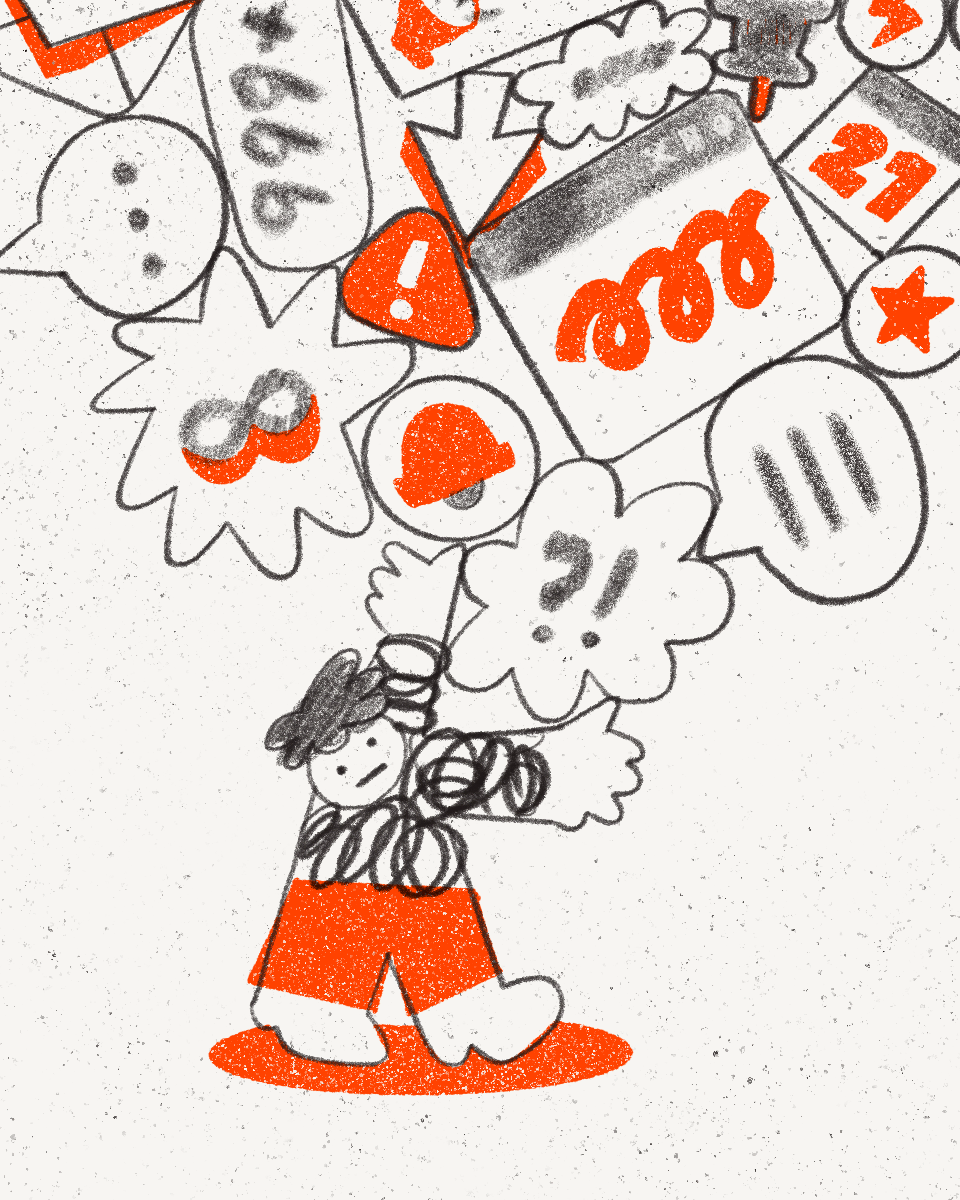
And that’s the bigger issue for most people who sit at desks for a living. Even if you get the phone out of the blast radius, the real battleground is the screen in front of you. That’s the whole reason Dropbox keeps talking about this problem: Knowledge workers are drowning in countless tabs and tools. My experiment was a physical solution, but the digital mess needs something different.
Researchers have been pointing in this direction: Distraction gets worse when you have too many options for your attention.
Dr. Maxi Heitmayer, a psychologist at Rowan University who studies what he calls “situated distraction,” told me that moving the phone out of reach doesn’t magically quiet the mind. It just changes the venue. “Moving the device out of reach does not reduce overall distraction; instead, workers simply shift those breaks and leisure engagements to their primary computer screen,” he says. In one study, participants used their phones three times as often when they were within reach. But when the phones were out of reach, they just used their computers to scratch the same itch.
Removing the phone didn’t fix my distraction problem but rather removed the one object capable of blowing up a stretch of focus with a finger tap
Then there’s the ambient distraction of just having your phone in sight. Dr. Kathrin Figl, a professor at the University of Innsbruck who studies flow, told me her team found students dropped into deep focus more easily when their phone was in another room. Not because the phone was actively siphoning their attention but because “having the phone on the desk made them feel more distracted,” and once they reached for it, “it broke the deep, focused engagement needed for effective learning.”
So removing the phone didn’t fix my distraction problem but rather removed the one object capable of blowing up a stretch of focus with a finger tap.
A funny thing happened once the phone disappeared: I started staring out the window at absolutely anything. A dog walker. A different dog walker. The same dog walker but with a different dog. Squirrels doing squirrel things. I realized that I may eventually need to put butcher paper over the lower half of my office window so I can stop tracking neighborhood foot traffic. These people need their privacy.
I do miss the phone sometimes, but the feeling is brief. And for every algorithmic hole I can avoid, that could be a sentence completed, or a minute I get back. It’s not a cure. It’s barely a hack. But if the phone stays in exile, and I get one more finished thought before lunch, I’ll count that as a win.
The Author


.png/_jcr_content/renditions/hero_square%20(1).webp)